Carbon Monoxide Safety

November 29, 2020

See How We're Different

GET A QUOTE

or call us: 303-834-1001

As the cold begins to set in, Carbon Monoxide Safety should be top of mind.  Be sure that you take the necessary precautions to prevent potential carbon monoxide (CO) leaks in your home.  Keep your family and pets safe! 

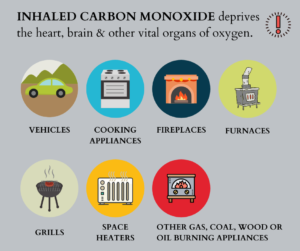
Fires and some forms of heating produce CO, a deadly colorless, odorless gas that can fill your house if you’re not careful. In the United States, CO leaks are responsible for an estimated 400 deaths a year and more than 20,000 trips to the emergency room, according to the Centers for Disease Control and Prevention (CDC). As CO poisoning often goes unreported, the number of instances is most likely much higher.
Here are the top Carbon Monoxide Safety Tips for your home:


Get your systems checked out by a professional

  • Defective furnaces, fireplaces, flues, and oil heaters are most frequently responsible for accidental CO poisonings.  
  • Have your heating system, water heater, and any other gas, oil, or coal burning appliances serviced by a qualified technician every year.⠀
  • Check your chimney or get it cleaned every year. Chimneys can be blocked by debris which can cause CO to build up inside your home.⠀
  • Make sure your gas appliances are vented properly. When improperly vented, malfunctioning home appliances like furnaces and air-conditioners can slowly fill your home with CO.

Don’t forget your CO detectors

  • In addition to smoke detectors, we recommend that you install a CO detector on each level of your home, and in or near each sleeping area. 
  • Keep detectors at least 20 feet from any fuel-burning appliances and at least 10 feet from high humidity locations like bathrooms and kitchens if you can, as moisture can sometimes trigger faulty readings.
  • If you can, hook up CO detectors to a smart home system to send a message to your smartphone if it’s detected when you’re not at home. 
  • Make sure you test the batteries regularly.

Use your appliances wisely 

  • Do not use portable flameless chemical heaters indoors.⠀
  • Never use a generator inside your home, basement, or garage or less than 20 feet from any window, door, or vent.
  • Keep in mind that space heaters, ovens, portable generators, and other gasoline-powered engines can cause a buildup of carbon monoxide. If you suspect the appliance or tool you’re using might be causing a buildup of CO, open a window immediately. Ventilation is a sure way to disperse a buildup of the gas.


Take the time now to assess your potential carbon monoxide risks in order to protect you and your family this winter . 

The post Carbon Monoxide Safety appeared first on Pure Risk Advisors.

Article By:

John Jacquat

Founder & President

Recent Posts

How Employee Wellness Programs Actually Save Money
February 5, 2026
Learn how strategic employee wellness programs cut healthcare costs, reduce absenteeism, boost retention, and deliver measurable ROI for businesses.
How Colorado Employers Reduce Payroll Taxes via Wellness Programs
February 5, 2026
Discover how Colorado employers cut payroll taxes with wellness programs using Section 125 plans, pre-tax benefits, and healthier workforces that boost ROI.
Streamline the TruBenefit Enrollment and Agent Support
February 5, 2026
TruBenefit streamlines enrollment and agent support with automation, centralized tools, and compliance features for faster, accurate benefits management.
How TruBenefit Empowers Small & Mid-Size Businesses
February 5, 2026
TruBenefit helps small and mid-size businesses streamline benefits, reduce costs, stay compliant, and boost employee recruitment and retention.
Wellness Program Payroll Tax Savings Calculator
January 21, 2026
Discover how wellness programs can cut healthcare costs and payroll taxes. Use a payroll tax savings calculator to quantify ROI and boost productivity.
Show More

Speak with us today!

We can help you with any of your insurance needs!

How Employee Wellness Programs Actually Save Money
February 5, 2026
Learn how strategic employee wellness programs cut healthcare costs, reduce absenteeism, boost retention, and deliver measurable ROI for businesses.
How Colorado Employers Reduce Payroll Taxes via Wellness Programs
February 5, 2026
Discover how Colorado employers cut payroll taxes with wellness programs using Section 125 plans, pre-tax benefits, and healthier workforces that boost ROI.
Streamline the TruBenefit Enrollment and Agent Support
February 5, 2026
TruBenefit streamlines enrollment and agent support with automation, centralized tools, and compliance features for faster, accurate benefits management.
How TruBenefit Empowers Small & Mid-Size Businesses
February 5, 2026
TruBenefit helps small and mid-size businesses streamline benefits, reduce costs, stay compliant, and boost employee recruitment and retention.
Wellness Program Payroll Tax Savings Calculator
January 21, 2026
Discover how wellness programs can cut healthcare costs and payroll taxes. Use a payroll tax savings calculator to quantify ROI and boost productivity.
Self-Insured Medical Reimbursement Plan (SIMRP) Explained
January 21, 2026
Learn how a Self-Insured Medical Reimbursement Plan (SIMRP) works, including benefits, risks, cost control strategies, and stop-loss protection.
Section 125 Cafeteria Plan Setup for Employers
January 21, 2026
A step-by-step guide to setting up a Section 125 Cafeteria Plan, covering tax savings, compliance, employee benefits, and best practices.
ACA-Compliant Preventative Care Management Program
January 21, 2026
Explore ACA-compliant preventive care management, covering zero cost-sharing services, patient outcomes, compliance challenges, and digital health solutions.
Colorado Employee Wellness Program
November 19, 2025
Colorado’s TruBenefit wellness program helps employers cut payroll taxes, boost retention, and give employees access to preventative care at no net cost.
What role does flood insurance play for condo associations, and when is it required?
November 4, 2025
Flood insurance protects Florida condo associations’ buildings and common areas. Required in high-risk zones or for government-backed mortgages.